No products in the cart.
When warehouse managers purchase forklifts, most focus on price, lifting capacity, or delivery time. However, once forklifts enter daily operations, safety issues often become the biggest hidden cost.
A forklift accident does not only damage equipment. It can also lead to:
- Product damage
- Delayed shipments
- Injured employees
- Warehouse downtime
- Higher maintenance costs
- Customer complaints
For modern warehouses, forklift safety is no longer just an operational issue. It directly affects efficiency, profitability, and long-term business stability.
Why Forklift Safety Becomes More Important as Warehouses Grow
Many warehouse buyers experience the same situation.
At the beginning:
- Few forklifts
- Small warehouse space
- Simple workflows
Everything seems manageable.
But as business grows:
- More forklifts enter the warehouse
- Aisles become crowded
- Shipping schedules become tighter
- More workers move around daily
Small safety problems quickly become expensive operational risks.
This is why experienced warehouse managers now treat forklift safety inspections as part of daily warehouse management instead of occasional maintenance work.
The Real Cost of Unsafe Forklift Operations
Many companies underestimate how expensive forklift accidents can become.
Repairing a forklift is only part of the cost.
The bigger losses usually come from:
- Delayed loading operations
- Damaged inventory
- Interrupted warehouse workflow
- Reduced productivity
- Lost customer trust
For example:
If one forklift stops working during peak warehouse hours, the entire loading process may slow down.
If an operator uses a forklift with worn tires or weak brakes, accident risks increase significantly.
For most warehouses, prevention is far cheaper than downtime and emergency repairs.
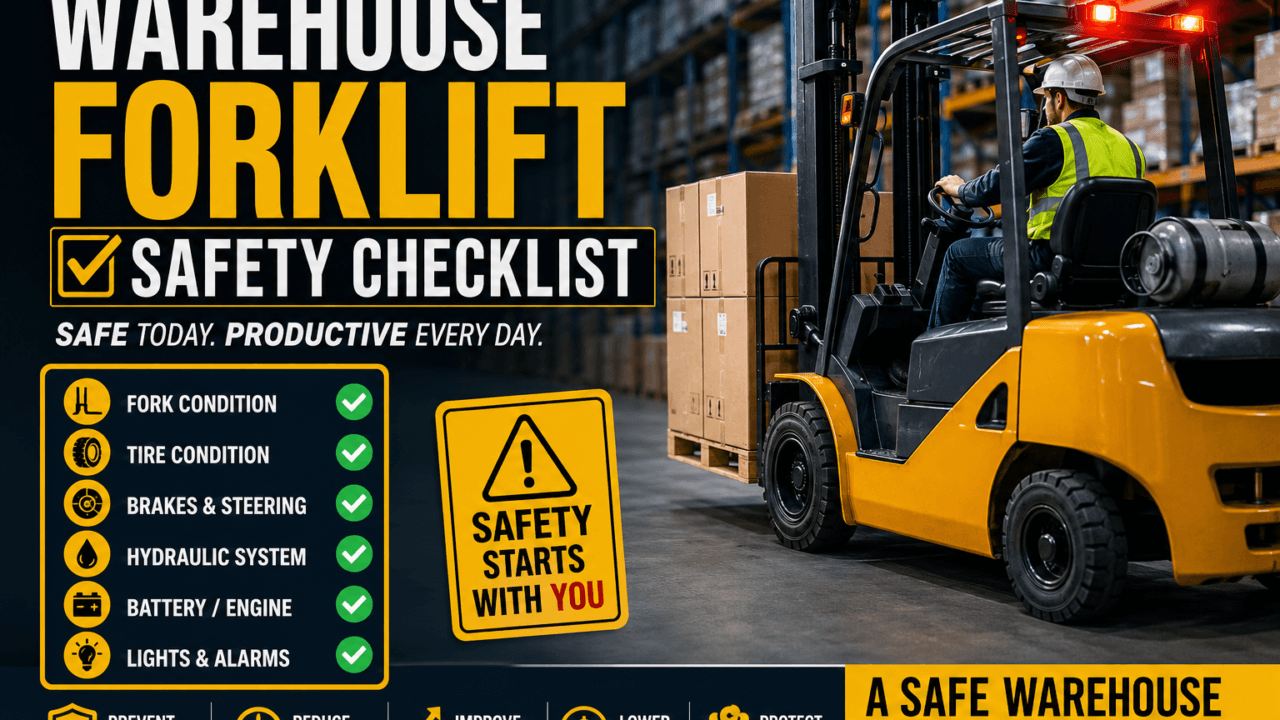
Daily Warehouse Forklift Safety Checklist
Experienced warehouse operators understand one important fact:
Most forklift accidents do not happen suddenly.
Small warning signs usually appear first.
That is why daily inspection matters.
1. Fork Inspection
Check:
- Cracks
- Bent forks
- Uneven fork height
- Excessive wear
Damaged forks may reduce lifting stability and increase accident risk.
2. Tire Inspection
Forklift tires directly affect:
- Stability
- Braking performance
- Steering control
Many buyers focus heavily on forklift price while ignoring long-term tire wear costs.
Read our forklift tire types guide for more information.
3. Brake and Steering Check
Before every shift:
- Test braking response
- Check steering smoothness
- Listen for abnormal noises
In busy warehouse environments, even small steering problems can create serious safety risks.
4. Hydraulic System Inspection
Hydraulic system issues are one of the most common forklift problems.
Inspect for:
- Oil leakage
- Slow lifting
- Mast vibration
- Hose damage
Many operators ignore slow lifting until the forklift completely stops working.
5. Battery or Engine Inspection
Electric Forklift
Check:
- Battery condition
- Charging status
- Cable connections
Battery issues are one of the biggest causes of electric forklift downtime.
Read our electric forklift battery guide.
Diesel Forklift
Inspect:
- Fuel system
- Engine condition
- Exhaust system
What Smart Warehouse Buyers Care About Today
Several years ago, many buyers mainly compared:
- Price
- Brand
- Capacity
Today, experienced warehouse buyers care more about:
- Long-term operating cost
- Downtime risk
- Maintenance efficiency
- Operator safety
- Parts availability
Because forklifts are no longer simply lifting equipment.
They directly affect warehouse efficiency and delivery performance.
Safety Is Also a Purchasing Decision
Many buyers only think about:
- Purchase cost
- Shipping cost
- Delivery time
But experienced warehouse managers understand:
A cheaper forklift is not truly cheaper if:
- Maintenance is frequent
- Downtime is high
- Safety risks increase
This is why more companies now prefer forklifts with:
- Better stability
- Easier maintenance
- Safer operation
- Better warehouse adaptability
Conclusion
Forklift safety is not only about preventing accidents.
It is also about:
- Protecting warehouse productivity
- Reducing operational losses
- Improving long-term profitability
For warehouse buyers, choosing the right forklift and building proper safety inspection procedures are equally important.
The warehouses that operate safely are usually the warehouses that operate efficiently.