No products in the cart.
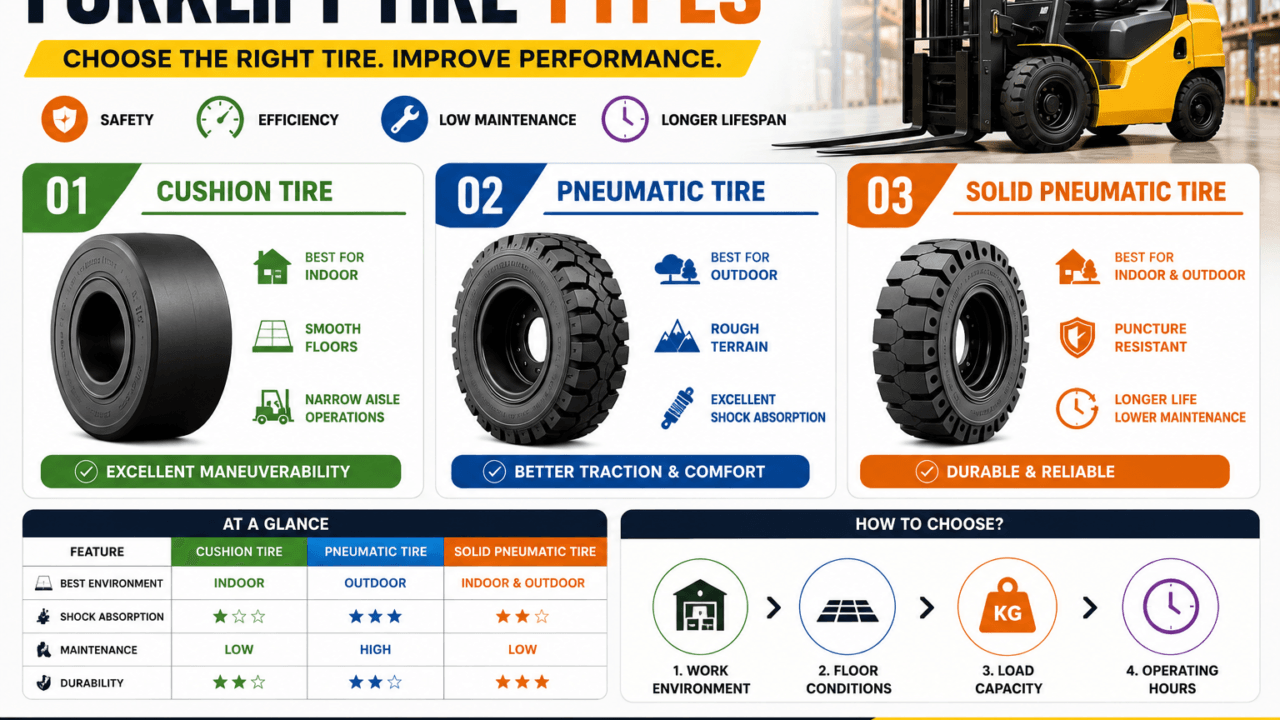
Forklift tires are one of the most important components affecting warehouse efficiency, forklift safety, and operating costs. Choosing the right forklift tire type can improve traction, reduce maintenance costs, extend tire lifespan, and protect warehouse flooring.
In this forklift tire guide, we’ll explain:
- The main forklift tire types
- Cushion tires vs pneumatic tires
- Indoor vs outdoor forklift tires
- How to choose the best forklift tire
- Common forklift tire problems and maintenance tips
For a complete overview of forklift equipment and applications, visit our Forklift Types and Applications Guide.
Why Forklift Tires Matter
Forklift tires directly affect:
- Forklift stability
- Load handling performance
- Operator comfort
- Fuel or battery efficiency
- Tire lifespan
- Warehouse floor protection
- Workplace safety
Using the wrong forklift tires can cause:
- Faster tire wear
- Reduced traction
- Higher maintenance costs
- Increased downtime
- Damage to warehouse flooring
- Lower operational efficiency
Proper forklift tire selection helps businesses reduce long-term operating costs while improving productivity.
Main Forklift Tire Types
There are three main forklift tire categories used in warehouse and industrial operations.
1. Cushion Tires
Cushion tires are solid rubber tires designed primarily for indoor warehouse applications.
Best For
- Indoor warehouses
- Smooth concrete floors
- Narrow aisle operations
- Distribution centers
Advantages of Cushion Tires
- Smaller turning radius
- Better maneuverability
- Lower forklift height
- Lower maintenance requirements
- Ideal for compact warehouse spaces
Limitations
- Poor performance on rough terrain
- Less shock absorption
- Not suitable for outdoor construction sites
Common Applications
Cushion tires are commonly used on:
- Electric forklifts
- Warehouse forklifts
- Reach trucks
- Indoor material handling equipment
👉 Often paired with electric forklift models for warehouse operations.
2. Pneumatic Tires
Pneumatic forklift tires are air-filled tires similar to truck tires.
Best For
- Outdoor forklift operations
- Rough terrain
- Uneven surfaces
- Construction sites
- Lumber yards
Advantages of Pneumatic Tires
- Excellent shock absorption
- Better outdoor traction
- More comfortable driving experience
- Improved stability on uneven ground
Limitations
- Higher puncture risk
- More maintenance required
- Tire pressure monitoring needed
Common Applications
Pneumatic tires are widely used on:
- Diesel forklifts
- Heavy-duty forklifts
- Outdoor material handling equipment
👉 Commonly used for diesel forklift applications and outdoor logistics operations.
3. Solid Pneumatic Tires
Solid pneumatic tires combine the durability of solid rubber with the design of pneumatic tires.
Best For
- Mixed indoor and outdoor use
- Heavy-duty industrial environments
- High-intensity forklift operations
Advantages
- Puncture resistant
- Longer service life
- Lower maintenance costs
- Better durability in industrial environments
Limitations
- Higher upfront cost
- Slightly rougher ride than air-filled tires
Common Applications
Ideal for:
- Ports
- Manufacturing plants
- Steel handling
- Multi-shift warehouse operations
Solid pneumatic tires are increasingly popular because they reduce downtime caused by punctures.
Cushion Tire vs Pneumatic Tire
Quick Comparison
| Feature | Cushion Tire | Pneumatic Tire |
|---|---|---|
| Best Environment | Indoor | Outdoor |
| Shock Absorption | Lower | Higher |
| Maneuverability | Excellent | Moderate |
| Surface Type | Smooth floors | Rough terrain |
| Maintenance | Low | Higher |
| Turning Radius | Smaller | Larger |
| Ride Comfort | Moderate | Better |
How to Choose the Right Forklift Tire
Choosing the best forklift tire depends on your operating environment, floor conditions, and load requirements.
1. Consider Your Work Environment
Indoor Warehouse Operations
Recommended tires:
- Cushion tires
- Solid tires
These tires provide:
- Better maneuverability
- Lower maintenance
- Warehouse floor protection
Outdoor Operations
Recommended tires:
- Pneumatic tires
- Solid pneumatic tires
These provide:
- Better traction
- Improved stability
- Better rough terrain handling
2. Evaluate Floor Conditions
Smooth Concrete Floors
Best choice:
- Cushion tires
Ideal for:
- Warehouses
- Retail logistics centers
- Distribution hubs
Rough or Uneven Surfaces
Best choice:
- Pneumatic tires
Suitable for:
- Gravel yards
- Construction sites
- Outdoor industrial environments
3. Consider Forklift Load Capacity
Heavy loads require stronger and more durable forklift tires.
Important factors include:
- Tire wear resistance
- Heat resistance
- Load distribution capability
👉 Read our Forklift Capacity Guide to select the correct forklift size and capacity.
4. Consider Operating Hours
For high-intensity or multi-shift operations, prioritize:
- Longer tire lifespan
- Lower maintenance costs
- Puncture resistance
Solid pneumatic tires are often the best solution for continuous industrial use.
Common Forklift Tire Problems
Uneven Tire Wear
Possible Causes
- Incorrect tire pressure
- Poor wheel alignment
- Overloading
- Aggressive driving
Tire Cracking
Common Causes
- Aging rubber
- Excessive heat
- Chemical exposure
- Outdoor UV exposure
Reduced Tire Traction
Possible Causes
- Worn tire tread
- Wet warehouse floors
- Incorrect tire type selection
Reduced traction can increase forklift accident risk and reduce operational safety.
Forklift Tire Maintenance Tips
Proper forklift tire maintenance improves safety and extends equipment lifespan.
Forklift Tire Maintenance Checklist
- Inspect tires regularly
- Check for cracks and uneven wear
- Maintain proper tire pressure
- Avoid overloading
- Rotate tires when necessary
- Remove debris from tire surfaces
Routine maintenance can significantly reduce downtime and tire replacement costs.
👉 Follow our Forklift Maintenance Checklist for daily inspections.
Which Forklift Tire Is Best for Warehouses?
Quick Answer (Featured Snippet Optimization)
- Cushion tires are best for indoor warehouse operations
- Pneumatic tires are ideal for outdoor and rough terrain applications
- Solid pneumatic tires provide the best balance for mixed environments
- Electric forklifts commonly use cushion tires
- Diesel forklifts typically use pneumatic tires
How Long Do Forklift Tires Last?
Forklift tire lifespan depends on:
- Usage intensity
- Floor conditions
- Load weight
- Driving habits
- Maintenance quality
Average Forklift Tire Lifespan
| Tire Type | Average Lifespan |
|---|---|
| Cushion Tires | 2,000–5,000 hours |
| Pneumatic Tires | 1,500–4,000 hours |
| Solid Pneumatic Tires | Longer in heavy-duty environments |
Proper tire maintenance can significantly extend service life.
Best Forklift Tires for Different Applications
| Application | Recommended Tire Type |
|---|---|
| Indoor Warehouse | Cushion Tire |
| Narrow Aisle Warehouse | Cushion Tire |
| Outdoor Yard | Pneumatic Tire |
| Construction Site | Pneumatic Tire |
| Heavy Industrial Use | Solid Pneumatic Tire |
| Mixed Indoor/Outdoor | Solid Pneumatic Tire |
Conclusion
Choosing the right forklift tire improves:
- Workplace safety
- Forklift stability
- Productivity
- Tire lifespan
- Operating efficiency
The best forklift tire depends on:
- Work environment
- Floor condition
- Load requirements
- Operating intensity
- Indoor or outdoor usage
Selecting the correct forklift tire can reduce downtime, lower maintenance costs, and improve long-term operational performance.
FAQs
1. What are the main types of forklift tires?
The three main forklift tire types are:
- Cushion tires
- Pneumatic tires
- Solid pneumatic tires
2. Which forklift tire is best for indoor warehouses?
Cushion tires are usually the best option for smooth indoor warehouse floors because they provide excellent maneuverability and lower maintenance costs.
3. Are pneumatic tires good for warehouse use?
Pneumatic tires are better suited for outdoor environments and rough terrain rather than smooth indoor warehouse floors.
4. How often should forklift tires be inspected?
Forklift tires should be inspected daily or weekly depending on operating intensity and working conditions.