
No products in the cart.
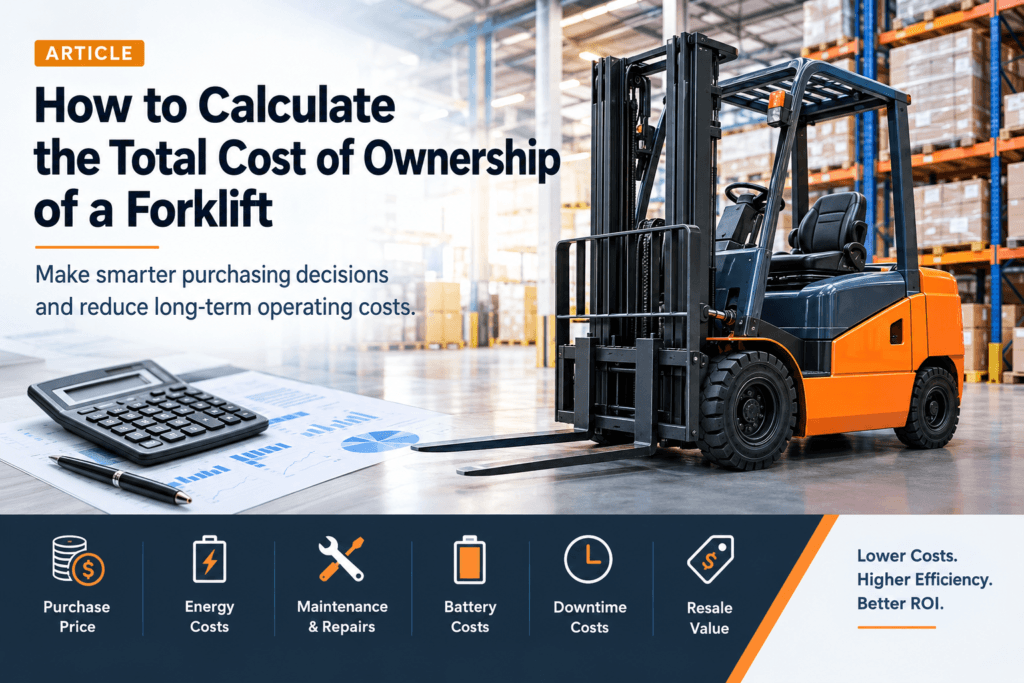
How to Calculate the Total Cost of Ownership of a Forklift
When comparing forklifts, most buyers start with the same question: How much does the machine cost?
But the purchase price does not tell you how much the forklift will actually cost your business over the next five years.
Two forklifts with similar specifications can have very different operating costs. One may consume less energy, require fewer repairs, and remain available throughout busy shifts. Another may cost less initially but generate higher maintenance expenses, longer downtime, and additional labor costs.
For warehouse managers, purchasing managers, and business owners, the more important question is not simply which forklift is cheaper. It is which forklift delivers the best value over its working life.
Understanding forklift ownership costs is one part of making a smart purchasing decision. For a broader overview of equipment selection, warehouse layout, and long-term operating efficiency, read our warehouse material handling equipment buyer’s guide.
This is where Total Cost of Ownership (TCO) becomes useful.
In this guide, we’ll explain how to calculate forklift total cost of ownership, identify the costs buyers often overlook, and compare two hypothetical forklift investments using a five-year cost model.
What Is the Total Cost of Ownership of a Forklift?
The total cost of ownership of a forklift is the total amount your business spends to purchase, operate, maintain, and eventually dispose of the equipment over a defined period.
Unlike the initial purchase price, TCO considers the costs that accumulate throughout the forklift’s service life.
These typically include:
- Initial purchase price
- Electricity, fuel, or other energy costs
- Scheduled maintenance and repairs
- Tires and replacement components
- Battery maintenance or replacement, where applicable
- Downtime and its operational impact
- Training and other relevant operating expenses
- Resale value at the end of the ownership period
Not every cost applies equally to every forklift. For example, an electric forklift may involve battery replacement expenses, while a diesel forklift has fuel, engine servicing, and exhaust-related maintenance considerations.
The correct calculation depends on the equipment type, workload, operating environment, and ownership period.
The Forklift Total Cost of Ownership Formula
A practical way to calculate forklift TCO is:
TCO = Purchase Price + Energy Costs + Maintenance and Repairs + Battery Costs + Downtime Costs + Other Ownership Costs − Resale Value
For a five-year comparison, estimate each cost over the same five-year period.
To compare different forklifts fairly, use consistent assumptions for annual operating hours, workload, ownership period, and accounting treatment.
You can also calculate the average annual ownership cost:
Average Annual Cost = Five-Year TCO ÷ 5
For a cost-per-hour comparison:
Cost per Operating Hour = Five-Year TCO ÷ Total Operating Hours
These figures make it easier to compare equipment with different purchase prices and operating expenses.
However, cost per hour should be interpreted alongside productivity. A forklift that costs slightly more per hour may still be the better investment if it safely handles more work in the same amount of time.
1. Start with the Initial Purchase Price
The purchase price is the easiest cost to identify, but it should be recorded accurately rather than used as the only decision-making factor.
When comparing supplier quotations, confirm what each price actually includes.
Check whether the quotation covers:
- The forklift and specified attachments
- Battery and charger, if applicable
- Required accessories and safety equipment
- Delivery to your facility or port
- Import duties, taxes, and customs clearance, where applicable
- Commissioning or operator training, if offered
For international purchases, freight, insurance, customs clearance, and local delivery can make a significant difference to the final landed cost.
Do not compare an equipment-only quotation with a delivered quotation and assume the cheaper figure represents better value.
Buyer tip: Request an itemized quotation so you can compare equivalent equipment, configurations, and delivery terms.
2. Calculate Electricity or Fuel Costs
Energy is one of the recurring costs that can significantly affect forklift ownership expenses, especially when the equipment operates for long hours.
For an electric forklift, estimate annual electricity consumption using actual or supplier-provided energy consumption data.
Annual Electricity Cost = Annual Electricity Consumption (kWh) × Electricity Price per kWh
For an internal combustion forklift:
Annual Fuel Cost = Annual Fuel Consumption × Fuel Price per Unit
For example, a forklift operating eight hours per day may have very different energy costs depending on its workload, travel distance, lifting frequency, load weight, and idle time.
Operating hours alone do not provide an accurate consumption estimate.
When requesting quotations, ask suppliers for realistic energy consumption estimates under conditions similar to your operation. If possible, validate those estimates using operating records from comparable equipment.
Also consider charging practices, battery charging efficiency, ventilation requirements, and any infrastructure costs relevant to your facility.
If you’re comparing energy expenses across different equipment types, our guide to electric vs. diesel forklifts explains the key differences in operating costs, maintenance, and application suitability.
3. Estimate Maintenance and Repair Costs
Maintenance expenses include routine servicing as well as unexpected repairs.
Common cost items include:
- Scheduled inspections and servicing
- Hydraulic system maintenance
- Brake and tire replacement
- Forks, chains, and wear components
- Electrical or electronic component repairs
- Engine and transmission servicing, where applicable
- Technician labor and service travel
Maintenance costs depend heavily on operating hours, working conditions, equipment quality, maintenance practices, and access to qualified technicians.
A forklift used in a clean warehouse for one shift per day may have a very different maintenance profile from one working multiple shifts in a dusty industrial yard.
To improve your estimate, ask suppliers for the recommended maintenance schedule, service intervals, common replacement parts, and indicative parts prices.
If you already operate similar forklifts, your maintenance records are often more useful than a generic industry estimate.
To build a consistent maintenance routine, use our forklift maintenance checklist to review common inspection points and scheduled servicing requirements.
4. Include Battery Costs for Electric Forklifts
Battery expenses deserve separate attention when comparing electric forklifts.
Depending on the battery technology and operating conditions, costs may include routine battery care, eventual replacement, charging equipment, and any infrastructure required for charging.
The key question is not simply how much a replacement battery costs. It is whether the battery’s expected service life matches your planned ownership period and operating intensity.
Ask suppliers to clarify:
- Battery chemistry and rated capacity
- Expected performance under your operating conditions
- Charging requirements and recommended practices
- Warranty coverage and exclusions
- Replacement battery availability and indicative cost
Avoid assuming that every battery will need replacement within the same period. Actual service life depends on battery type, charging habits, temperature, workload, and maintenance.
For a fair TCO comparison, include a replacement expense only when it is reasonably expected during the selected ownership period. If the timing is uncertain, prepare alternative scenarios.
Battery selection and charging practices can affect long-term operating expenses. Read our electric forklift battery guide for more information about battery performance, charging requirements, and maintenance considerations.
5. Calculate the Cost of Equipment Downtime
Downtime is one of the most overlooked elements in forklift TCO calculations.
When a forklift becomes unavailable, your business may need to rent replacement equipment, assign workers to other tasks, rearrange warehouse operations, or delay shipments.
However, it is important to avoid counting the same loss twice.
A practical calculation is:
Downtime Cost = Unplanned Downtime Hours × Estimated Additional Cost per Hour
The hourly cost should reflect the actual financial impact of equipment unavailability.
For example, if a warehouse must rent replacement equipment during a breakdown, include the additional rental expense. If a production line stops and causes measurable lost output, estimate that impact separately.
Do not automatically multiply downtime hours by every employee’s wage. If employees can continue productive work elsewhere, their full wages may not represent an additional cost.
When comparing suppliers, consider parts lead times, local service availability, technical documentation, and the ability to obtain replacement components quickly.
The purpose is to estimate the likely cost of interruptions, not to assume that every breakdown results in a complete operational shutdown.
6. Subtract the Expected Resale Value
A forklift may retain some value at the end of the ownership period.
Its resale value depends on factors such as:
- Equipment age and operating hours
- Maintenance and service history
- Overall condition
- Market demand
- Battery condition, where applicable
- Availability of replacement parts
- Local regulations and resale restrictions
For a five-year TCO calculation, estimate the amount your business could reasonably recover when selling the equipment at the end of year five.
Use conservative estimates and make sure the ownership period is consistent across all equipment being compared.
A high resale estimate can make a machine appear artificially economical, so it should be supported by market evidence whenever possible.
A Five-Year Forklift TCO Example
Consider a business comparing two hypothetical electric forklifts for the same warehouse operation.
Both machines are assumed to perform the same workload for five years. The following figures are illustrative only and are not supplier quotations or verified market averages.
| Cost Category | Forklift A | Forklift B |
|---|---|---|
| Purchase price | $18,000 | $21,000 |
| Five-year electricity | $5,000 | $4,000 |
| Maintenance and repairs | $4,500 | $3,500 |
| Battery costs | $2,000 | $1,000 |
| Downtime-related costs | $2,500 | $1,000 |
| Other ownership costs | $1,000 | $1,000 |
| Less estimated resale value | −$4,000 | −$5,000 |
| Five-year TCO | $29,000 | $26,500 |
| Average annual cost | $5,800 | $5,300 |
In this example, Forklift B costs $3,000 more initially but has an estimated five-year TCO that is $2,500 lower.
The average annual ownership cost is $500 lower.
This illustrates why the lowest purchase price does not necessarily represent the lowest long-term cost.
However, these results depend entirely on the assumptions. If actual energy consumption, maintenance expenses, downtime, or resale value differ, the outcome may change.
Before making a decision, replace these illustrative figures with supplier quotations, your own operating records, and realistic estimates for your warehouse.
How to Compare Forklift Supplier Quotations Fairly
A useful TCO calculation is only as reliable as the information used to build it.
When comparing two or more suppliers, prepare a standardized comparison sheet.
For each machine, record:
- Purchase price and included configuration
- Delivery and installation costs
- Expected annual operating hours
- Estimated energy or fuel consumption
- Planned maintenance schedule
- Common replacement part prices
- Battery warranty and replacement assumptions, where applicable
- Warranty terms and exclusions
- Service response arrangements and parts lead times
- Expected resale value after the same ownership period
Ask each supplier to explain the assumptions behind their estimates.
If one supplier estimates maintenance costs using light-duty operation while another assumes intensive multi-shift use, their figures are not directly comparable.
Likewise, verify that both quotations cover the same rated capacity, lifting height, attachments, and other operational requirements.
The goal is to compare equivalent solutions under equivalent operating conditions—not simply to compare two prices.
Common Mistakes When Calculating Forklift TCO
Comparing different equipment configurations
A lower-priced forklift may not offer the lifting capacity, mast height, battery configuration, or attachments required by your operation. Compare machines that meet the same requirements first.
Using unrealistic maintenance estimates
Maintenance costs depend on usage and working conditions. Use service schedules and operating records instead of assuming that every forklift will incur the same annual expense.
Ignoring spare parts lead times
A replacement component may be inexpensive but difficult to obtain. Evaluate both the cost of the part and the potential operational impact of waiting for it.
Overestimating resale value
Future resale prices are uncertain. Use conservative estimates and test how your calculation changes if resale proceeds are lower than expected.
Focusing only on cost per hour
A low cost per operating hour does not automatically mean better productivity. Equipment must also perform the required work safely, reliably, and within the necessary time.
When Should You Choose the Lowest-TCO Forklift?
The forklift with the lowest calculated TCO is often a strong candidate, provided it meets your operational requirements.
Before making the final decision, confirm that it can handle your actual loads, fit your warehouse layout, achieve the required lifting height, and support your daily workload.
Also consider local service availability, operator training, safety requirements, warranty coverage, and the supplier’s ability to provide technical support.
If one option has a slightly higher estimated TCO but offers a necessary operational advantage, the additional expense may still be justified.
A sound purchasing decision balances cost, productivity, safety, and operational risk.
Forklift TCO Checklist for Purchasing Managers
Before approving a forklift purchase, make sure you have:
- Confirmed the required load capacity and lifting height
- Measured aisle width and operating space
- Estimated annual operating hours
- Compared electricity or fuel consumption
- Reviewed scheduled maintenance requirements
- Checked replacement part prices and availability
- Evaluated battery costs, where applicable
- Estimated the financial impact of downtime
- Compared warranty terms and technical support
- Estimated resale value using reasonable assumptions
- Calculated total cost over the same ownership period
- Confirmed that all supplier quotations cover equivalent configurations
Completing this checklist helps you compare equipment based on its expected contribution to your business rather than relying on the purchase price alone.
Frequently Asked Questions
What is the total cost of ownership of a forklift?
Forklift total cost of ownership is the combined cost of purchasing, operating, maintaining, and eventually disposing of the equipment over a defined period, minus any resale value.
How do you calculate forklift operating costs?
Add the relevant energy or fuel expenses, maintenance, repairs, battery costs where applicable, and other recurring operating expenses. For a complete TCO calculation, also include the initial purchase price, downtime-related costs, and resale value.
How much does it cost to own a forklift for five years?
There is no single figure that applies to every forklift. Five-year ownership costs depend on the purchase price, equipment type, annual operating hours, energy prices, maintenance requirements, battery configuration, downtime, and resale value. A supplier quotation and your operating data provide a more reliable estimate.
Is an electric forklift cheaper to operate than a diesel forklift?
An electric forklift may offer lower energy and certain maintenance costs in suitable applications, but the result depends on electricity and fuel prices, operating intensity, battery requirements, equipment utilization, and local service costs. Compare both options using the same workload and ownership period.
What costs are often overlooked when buying a forklift?
Commonly overlooked costs include replacement parts, battery replacement, delivery, charging infrastructure, technician labor, unplanned downtime, and the difference between estimated and actual resale value.
How can I reduce forklift ownership costs?
Match the equipment to your workload, follow preventive maintenance schedules, manage battery charging correctly, compare supplier support, keep commonly needed parts accessible, and monitor actual operating costs over time.
Should I buy a forklift with a higher purchase price but lower operating costs?
It can be a good decision if the higher-priced machine has a lower expected TCO and meets your operational needs. Calculate the difference over the intended ownership period and verify the assumptions before purchasing.
Make Your Next Forklift Purchase a Better Investment
Choosing warehouse equipment is not just a purchasing decision. It is a long-term operating decision that affects productivity, maintenance budgets, and business continuity.
By calculating total cost of ownership, you can compare supplier quotations more accurately, identify hidden expenses, and understand what your investment is likely to cost over time.
Before purchasing your next forklift, gather realistic operating data, request itemized quotations, and compare the complete ownership cost rather than the initial price alone.
If you’re planning to purchase electric forklifts, diesel forklifts, LPG forklifts, or other warehouse material handling equipment, our team can help you review your application requirements and compare suitable options.
Contact us to discuss your warehouse equipment requirements and request a quotation tailored to your operation.


