No products in the cart.
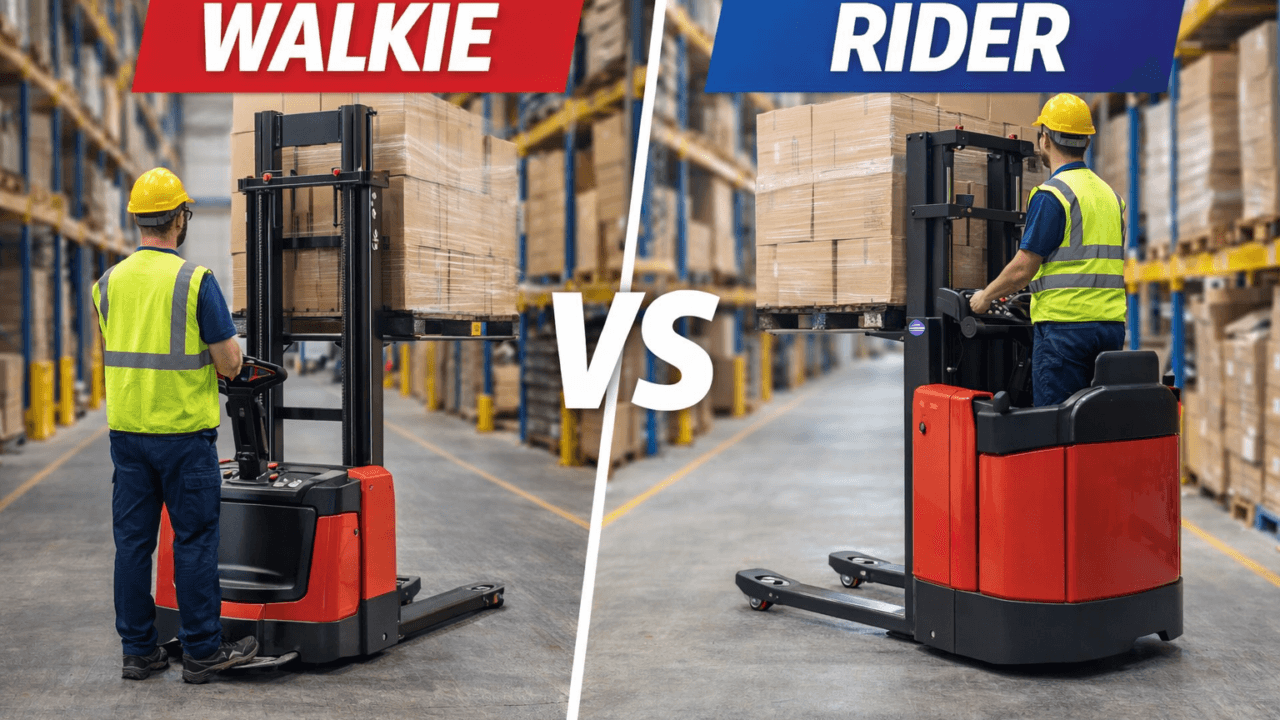
Compare walkie vs rider stackers in terms of cost, efficiency, space, and applications. Find out which type is best for your warehouse operation.
Walkie stackers are ideal for narrow aisles and short-distance tasks due to their compact design and low cost, while rider stackers are better for long-distance transport and high-efficiency operations thanks to higher speed and reduced operator fatigue.
Walkie vs Rider Stacker: Which One Is Better for Your Warehouse?
Choosing between a walkie stacker and a rider stacker is one of the most important decisions for warehouse efficiency.
Both are electric stackers—but they serve very different purposes.
In this guide, we’ll compare:
- Operation type
- Efficiency
- Cost
- Ideal applications
What Is a Walkie Stacker?
A walkie stacker is a walk-behind electric stacker where the operator controls the machine while walking.
Key characteristics:
- Compact size
- Tight turning radius
- Lower cost
- Best for indoor use
👉 It is widely used in:
- Small warehouses
- Retail backrooms
- Narrow aisle storage
For small warehouse applications, you can also read:
/electric-stacker-for-small-warehouse
What Is a Rider Stacker?
A rider stacker allows the operator to stand or ride on a platform while operating the machine.
Key characteristics:
- Higher travel speed
- Reduced operator fatigue
- Designed for longer distances
👉 It is commonly used in:
- Large warehouses
- Distribution centers
- High-frequency operations
If you’re evaluating capacity options, this guide may help:
/1-5-ton-electric-stacker-guide
Walkie vs Rider Stacker – Key Differences
| Feature | Walkie Stacker | Rider Stacker |
|---|---|---|
| Operator Position | Walk-behind | Ride-on / stand-on |
| Travel Speed | Low (walking speed) | Higher speed |
| Aisle Requirement | Narrow | Wider |
| Cost | Lower | Higher |
| Efficiency | Short-distance tasks | Long-distance & high throughput |
| Operator Fatigue | Higher over long use | Much lower |
👉 Walkie stackers prioritize maneuverability and cost, while rider stackers focus on speed and productivity.
You may also compare with forklifts here:
/electric-stacker-vs-forklift
When Should You Choose a Walkie Stacker?
A walkie stacker is the better choice if:
1. You Have Narrow Aisles
- Ideal for tight warehouse layouts
- Easier to maneuver in confined spaces
2. Your Transport Distance Is Short
- Best for localized operations
- Efficient for frequent short moves
3. You Have a Limited Budget
- Lower purchase cost
- Lower maintenance cost
4. Light to Medium Duty Work
- Typical capacity: 1–1.5 tons
- Indoor usage
When Should You Choose a Rider Stacker?
A rider stacker is the better option if:
1. You Handle Long Distances
- Ideal for large warehouses
- Improves efficiency over long travel routes
2. High Throughput Is Required
- Faster movement = more pallets per hour
- Suitable for continuous operations
3. You Want Better Operator Comfort
- No walking required
- Reduces fatigue during full shifts
4. Medium to Heavy Workload
- Better for intensive daily operations
Cost Comparison: Walkie vs Rider Stacker
| Cost Factor | Walkie Stacker | Rider Stacker |
| Initial Cost | Low | High |
| Maintenance | Lower | Higher |
| ROI | Better for small ops | Better for large ops |
👉 Walkie stackers are more cost-effective for small businesses, while rider stackers offer better ROI in high-volume operations.
Efficiency Comparison
- Walkie stacker → limited by walking speed
- Rider stacker → optimized for continuous movement and speed
👉 Over long distances, rider stackers significantly increase productivity.
Can You Use Both in One Warehouse?
Yes—and many warehouses do.
A common strategy:
- Walkie stackers → narrow aisles & storage zones
- Rider stackers → main transport routes
👉 This hybrid setup maximizes both space efficiency and productivity.
H2: Explore Electric Stacker Options
If you’re comparing different types of stackers, it’s useful to review a full range of configurations.
Explore electric stacker types
Final Thoughts
There is no “one-size-fits-all” solution.
- Choose a walkie stacker for flexibility, compact space, and cost control
- Choose a rider stacker for speed, efficiency, and long-distance handling
👉 The best choice depends on your warehouse layout and workload.