- by admin
- 0 Comments
- Blog
Table of Contents
Introduction
Purchasing warehouse material handling equipment is one of the most important investments a business can make. Whether you’re opening a new warehouse, expanding your storage capacity, or replacing aging equipment, the decisions you make today will directly impact your productivity, operating costs, and profitability for years to come.
However, many companies approach equipment purchasing in the wrong way.
They compare prices, request quotations from multiple suppliers, and choose the machine that appears to offer the best value on paper. While this may seem like a smart strategy, it often leads to unexpected costs after the equipment is delivered.
A forklift that doesn’t fit your warehouse layout slows down operations. Equipment with frequent maintenance issues increases downtime. Choosing a machine that only meets today’s workload may require another investment much sooner than expected.
The purchase price is only the beginning.
The real cost of warehouse equipment includes maintenance, energy consumption, spare parts, operator efficiency, equipment downtime, and the ability to support future business growth.
This guide is designed for warehouse managers, purchasing managers, logistics professionals, and business owners who want to make informed decisions before investing in warehouse material handling equipment.
Rather than focusing on product specifications, we’ll help you understand how to evaluate your warehouse, identify your operational needs, and choose equipment that delivers long-term value.
Why Choosing the Right Warehouse Equipment Matters
When companies purchase warehouse equipment, they often focus on one question:
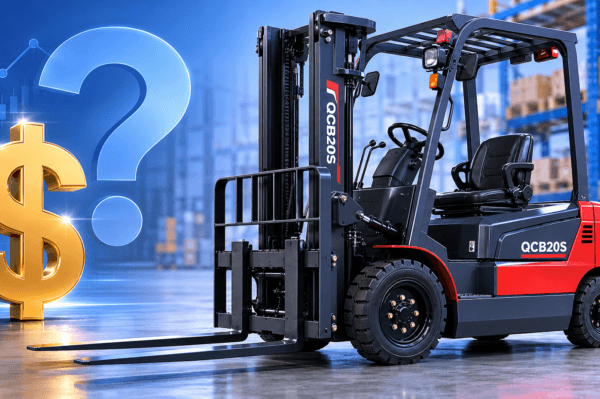
“How much does it cost?”
A better question would be:
“How much will it cost to own and operate over the next five years?”
The answer is very different.
A warehouse forklift may operate for thousands of hours every year. During its lifetime, the business will spend money on electricity or fuel, maintenance, replacement parts, tires, batteries, operator training, and scheduled servicing.
If the equipment is unreliable, even a single day of downtime can delay shipments, interrupt production, and increase labor costs.
Choosing the right equipment isn’t about buying the most expensive machine.
It’s about selecting equipment that matches your warehouse, supports your daily workflow, and helps your business operate more efficiently.
Companies that make purchasing decisions based on long-term value typically experience:
- Lower operating costs
- Higher warehouse productivity
- Less equipment downtime
- Improved employee efficiency
- Better return on investment
These benefits are rarely achieved by selecting the lowest-priced option.
Instead, they come from choosing the right solution for the right application.
The Hidden Costs Buyers Often Overlook
One of the biggest mistakes companies make is assuming that the purchase price represents the total investment.
In reality, the purchase price is only one part of the total cost of ownership.
For example, two forklifts may have a similar selling price, but their long-term operating costs can be completely different.
One machine may consume less energy, require fewer repairs, and offer better parts availability.
Another may experience frequent breakdowns, longer repair times, and higher maintenance expenses.
Over several years, the cheaper machine may actually become the more expensive investment.
When evaluating warehouse material handling equipment, buyers should consider:
- Daily operating efficiency
- Maintenance requirements
- Energy consumption
- Spare parts availability
- Equipment lifespan
- Downtime risk
- Future expansion needs
Looking beyond the purchase price helps businesses make decisions that support sustainable growth rather than short-term savings.
The Biggest Mistake Buyers Make
Many purchasing teams start by asking suppliers the same question:
“Which forklift do you recommend?”
The problem is that no supplier can answer this question without first understanding your warehouse.
The most successful warehouse projects don’t begin with equipment.
They begin with operations.
Before selecting any machine, experienced warehouse managers evaluate how products move through the warehouse, where bottlenecks occur, how much storage space is available, and how the business is expected to grow over the coming years.
The warehouse should determine the equipment—not the other way around.
For example, a manufacturing plant and an e-commerce fulfillment center may both require forklifts, but their operational priorities are completely different.
A manufacturing facility may prioritize load capacity and continuous operation.
An e-commerce warehouse may focus on fast order picking, narrow aisles, and maximizing storage density.
Although both businesses purchase material handling equipment, they require different solutions because their operations are different.
Understanding your workflow before requesting quotations will almost always lead to a better purchasing decision.
Five Questions Every Buyer Should Answer Before Comparing Suppliers
Before discussing brands, prices, or specifications, take the time to answer these five questions.
The answers will help you identify the equipment that truly fits your business.
1. What products move through your warehouse every day?
Different products require different handling methods.
Palletized consumer goods, food products, steel materials, construction supplies, and oversized equipment all place different demands on warehouse equipment.
Understanding your daily workload is the first step toward choosing the right solution.
2. How many pallets do you handle each day?
The number of daily pallet movements has a direct impact on equipment selection.
A warehouse processing fifty pallets per day has very different requirements from one moving two thousand pallets every day.
Higher workloads generally require equipment with greater durability, higher efficiency, and lower maintenance requirements.
3. What are your warehouse limitations?
Your warehouse layout is just as important as the equipment itself.
Consider factors such as:
- Aisle width
- Rack height
- Floor conditions
- Loading dock configuration
- Turning space
- Indoor or outdoor operation
Choosing equipment that fits your warehouse can significantly improve productivity without expanding your facility.
4. How will your business grow over the next three to five years?
Warehouse equipment is a long-term investment.
If your business is expected to grow, your equipment should be capable of supporting future demand.
Buying equipment that only meets today’s workload may lead to unnecessary replacement costs within a few years.
Planning ahead helps protect your investment.
5. What does one day of equipment downtime cost your business?
Most buyers know the purchase price of a forklift.
Few know the cost of a forklift that’s unavailable.
Delayed shipments, interrupted production, idle employees, missed delivery schedules, and dissatisfied customers all have financial consequences.
Reliable equipment, preventive maintenance, and readily available spare parts play an important role in reducing these risks.
When evaluating suppliers, after-sales support should be considered just as carefully as the equipment itself.
Making Better Purchasing Decisions Starts With Understanding Your Warehouse
Successful equipment purchasing isn’t about finding the cheapest machine or choosing the supplier with the longest specification sheet.
It’s about understanding your operation first.
Once you clearly understand your warehouse layout, workflow, daily workload, and future plans, comparing equipment becomes much easier.
Instead of asking, “Which forklift should I buy?”, you’ll begin asking a much more valuable question:
“Which solution will help my warehouse operate more efficiently over the next five years?”
That shift in thinking is often the difference between a purchase that simply meets today’s needs and an investment that continues creating value for years to come.
Different Warehouses Require Different Material Handling Solutions
One of the biggest misconceptions in warehouse equipment purchasing is believing there’s a single machine that’s perfect for every operation.
In reality, warehouse equipment should always be selected based on how your business operates—not simply on lifting capacity or purchase price.
A manufacturing plant has different priorities than an e-commerce fulfillment center.
A cold storage warehouse faces different challenges than a distribution center.
Choosing equipment that matches your operational environment improves productivity, reduces labor costs, and prevents unnecessary investment.
Before selecting any equipment, identify which warehouse environment best represents your business.
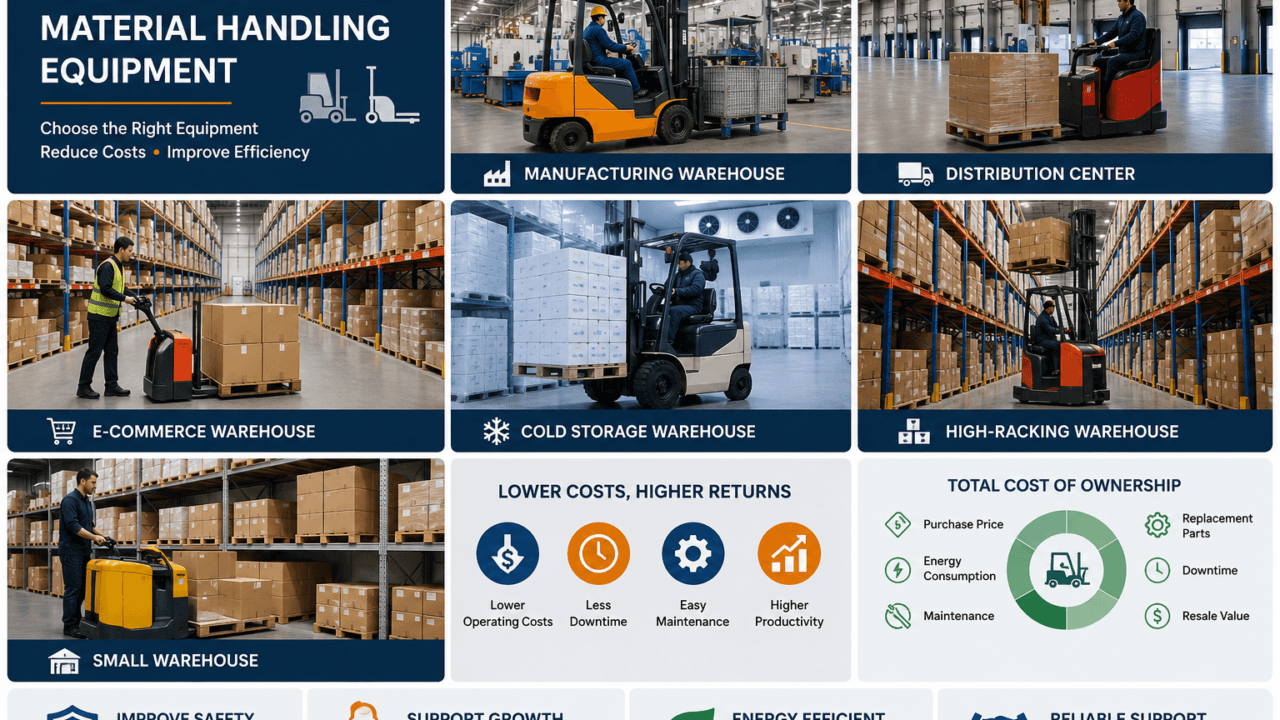
Manufacturing Warehouses
Manufacturing facilities typically move raw materials, semi-finished products, and finished goods between production lines and storage areas.
Unlike logistics warehouses, manufacturing operations require continuous material flow. Any interruption can affect production schedules and increase operating costs.
Key Challenges
- Continuous material transportation
- Heavy-duty daily operation
- Indoor and outdoor movement
- High equipment utilization
- Minimal downtime requirements
Recommended Equipment Strategy
Instead of purchasing the highest-capacity forklift available, manufacturers should focus on equipment reliability, operating efficiency, and maintenance intervals.
For example:
- Electric forklifts are ideal for indoor production workshops where low noise and zero emissions improve the working environment.
- Diesel forklifts remain suitable for outdoor loading yards and heavy-duty operations.
- Electric pallet trucks can efficiently transport materials between production lines while reducing operator fatigue.
The best solution is often a combination of equipment rather than relying on one machine to perform every task.
Distribution Centers
Distribution centers focus on speed.
The faster products move from receiving to storage and from storage to outbound shipping, the lower the operating cost.
Unlike manufacturing facilities, distribution centers prioritize efficiency over lifting capacity.
Key Challenges
- High daily pallet movement
- Multiple loading docks
- Tight shipping schedules
- Fast truck turnaround
- Peak season workload
Recommended Equipment Strategy
Warehouse managers should prioritize equipment that minimizes travel time and reduces operator fatigue.
A typical distribution center may combine:
- Electric forklifts for loading and unloading
- Electric pallet trucks for dock operations
- Reach trucks for pallet storage
Using different equipment for different tasks usually produces much higher efficiency than relying on one universal forklift.
E-commerce Fulfillment Warehouses
E-commerce has changed warehouse operations dramatically.
Instead of moving large quantities of the same product, fulfillment centers process thousands of small orders every day.
Order accuracy and picking speed become more important than lifting capacity.
Key Challenges
- High picking frequency
- Narrow warehouse aisles
- Fast order fulfillment
- Seasonal demand fluctuations
- Labor shortages
Recommended Equipment Strategy
Compact and highly maneuverable equipment performs best in this environment.
Businesses should focus on:
- Electric pallet trucks for horizontal transportation
- Reach trucks for high-density storage
- Electric forklifts for receiving and shipping operations
When warehouse space is limited, narrow aisle equipment can significantly increase storage capacity without expanding the building.
This is often one of the most cost-effective ways to improve warehouse productivity.
Related Reading:
Best Forklift for Warehouse: How to Choose the Right One
Cold Storage Warehouses
Cold storage operations place additional demands on warehouse equipment.
Low temperatures reduce battery performance, increase component wear, and create challenging working conditions for operators.
Equipment selection should therefore consider more than lifting performance.
Key Challenges
- Low-temperature operation
- Condensation
- Reduced battery efficiency
- Limited maintenance windows
- Safety concerns
Recommended Equipment Strategy
Warehouse managers should evaluate:
- Battery performance in low temperatures
- Waterproof electrical systems
- Anti-slip tires
- Reliable after-sales support
- Fast spare parts availability
Downtime inside a cold storage warehouse can quickly become expensive due to delayed shipments and temperature-sensitive inventory.
Related Reading:
Electric Forklift Battery Guide
High-Racking Warehouses
As warehouse space becomes more expensive, many businesses increase storage vertically rather than expanding horizontally.
High-racking warehouses require equipment capable of operating safely at greater lifting heights.
Key Challenges
- Limited aisle width
- High storage density
- Increased lifting height
- Accurate pallet positioning
- Operator visibility
Recommended Equipment Strategy
Standard counterbalance forklifts often require wider aisles than modern warehouses can provide.
Reach trucks are specifically designed to maximize vertical storage while operating efficiently in narrow aisles.
Although they may represent a higher initial investment, the additional storage capacity they create often delivers a much greater return over time.
If expanding your warehouse isn’t possible, optimizing existing storage space is often the smarter investment.
Related Reading:
Reach Truck vs Forklift: What’s the Difference?
Small Warehouses
Small warehouses face a different challenge.
Space is limited, budgets are tighter, and every purchasing decision has a greater financial impact.
Many businesses assume they need larger equipment to prepare for future growth.
In reality, oversized equipment often reduces available storage space and increases operating costs.
Key Challenges
- Limited floor space
- Budget constraints
- Multi-purpose operations
- Flexible daily workload
Recommended Equipment Strategy
Instead of purchasing multiple large machines, many small warehouses benefit from combining compact electric forklifts with electric pallet trucks.
This approach provides greater flexibility while keeping investment costs under control.
As the business grows, additional equipment can be added based on actual operational needs rather than assumptions.
Related Reading:
Narrow Aisle Forklift: The Best Solution for Small Warehouses
There Is No Universal Warehouse Equipment Solution
One lesson becomes clear across every successful warehouse project:
The best equipment isn’t the machine with the highest specifications.
It’s the equipment that fits the way your warehouse operates.
Before making a purchasing decision, consider:
- How products move through your warehouse
- Where operational bottlenecks occur
- How much storage capacity you need
- Whether your business is expected to grow
- Which equipment delivers the lowest long-term operating cost
By selecting equipment based on operational requirements instead of product specifications alone, businesses can improve warehouse efficiency while making smarter long-term investments.
How to Reduce Warehouse Operating Costs and Maximize Your Return on Investment
For many businesses, purchasing warehouse equipment is one of the largest operational investments they will make.
However, reducing costs isn’t about buying the cheapest machine.
It’s about selecting equipment that keeps your warehouse productive, minimizes downtime, and continues delivering value year after year.
Experienced warehouse managers rarely evaluate equipment based on purchase price alone. Instead, they focus on how the equipment will affect daily operations, maintenance expenses, labor efficiency, and future business growth.
A smart purchasing decision should lower your overall operating costs—not simply reduce your initial investment.
Understand the Total Cost of Ownership, Not Just the Purchase Price
One of the biggest purchasing mistakes is assuming that a lower purchase price automatically means a lower overall cost.
In reality, the purchase price is only the beginning.
The true cost of warehouse equipment includes every expense you’ll incur throughout its service life.
These costs typically include:
- Purchase price
- Energy or fuel consumption
- Preventive maintenance
- Replacement parts
- Tires and wear components
- Battery replacement
- Operator productivity
- Equipment downtime
- Resale value
When these factors are considered together, the least expensive machine is not always the most economical choice.
Many businesses discover that paying slightly more upfront can significantly reduce operating expenses over the next five to ten years.
Buyer Tip
Never compare quotations based only on purchase price.
Instead, compare the expected operating cost over the entire life of the equipment.
Every Hour of Downtime Has a Cost
Warehouse downtime is often underestimated because it doesn’t appear on the purchase quotation.
But when equipment stops working, the financial impact starts immediately.
One unavailable forklift can lead to:
- Delayed loading and unloading
- Slower order fulfillment
- Production interruptions
- Employees waiting for available equipment
- Missed delivery deadlines
- Customer complaints
- Overtime labor costs
For warehouses operating multiple shifts, even a few hours of downtime can disrupt the entire workflow.
This is why equipment reliability should always be considered alongside price.
Reducing downtime is often one of the fastest ways to improve warehouse profitability.
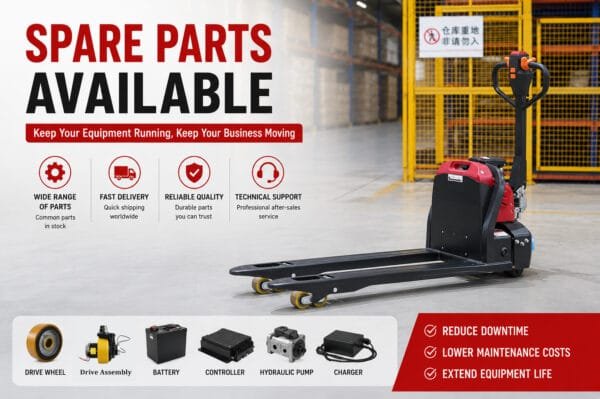
Why After-Sales Support Can Save Thousands of Dollars
Many buyers focus heavily on specifications but overlook what happens after the equipment arrives.
The real test of a supplier begins when maintenance or replacement parts are needed.
Imagine two suppliers offering similar equipment at similar prices.
One can ship replacement parts within a few days and provide technical support immediately.
The other takes several weeks to respond.
Although the equipment appears similar, the long-term operating experience will be completely different.
Before making a purchasing decision, ask suppliers:
- Are commonly used spare parts available?
- How quickly can replacement parts be shipped?
- Is technical support available?
- Can maintenance manuals be provided?
- Will you receive assistance after delivery?
Reliable after-sales support reduces downtime, lowers maintenance costs, and protects your investment over the long term.
Related Reading
Why Spare Parts Availability Matters When Choosing an Electric Pallet Truck
Preventive Maintenance Is Always Cheaper Than Emergency Repairs
Waiting until equipment breaks down is one of the most expensive maintenance strategies.
Small problems are usually inexpensive to repair.
Large failures often require expensive parts, additional labor, and unexpected downtime.
A simple preventive maintenance schedule helps businesses avoid these risks.
Regular inspections should include:
- Tire condition
- Hydraulic system
- Battery charging
- Brake performance
- Mast lubrication
- Fork inspection
- Safety devices
Consistent maintenance not only extends equipment life but also improves operator safety and reduces unexpected repair costs.
Related Reading
Forklift Maintenance Checklist
Buy Equipment for Tomorrow, Not Just Today
Warehouse equipment is expected to operate for many years.
Your business, however, will continue to change.
Production may increase.
Storage capacity may expand.
Customer demand may grow.
Order volumes may double.
Purchasing equipment that only meets today’s requirements often leads to another investment much sooner than expected.
Instead of asking,
“What do we need today?”
Ask,
“What will our warehouse need three to five years from now?”
Planning ahead allows businesses to maximize equipment utilization while avoiding unnecessary replacement costs.
A Reliable Supplier Creates More Value Than a Lower Price
Choosing warehouse equipment is also choosing a long-term business partner.
A professional supplier should help you solve operational challenges—not simply provide a quotation.
When comparing suppliers, consider more than product specifications.
Look for a supplier that offers:
- Professional equipment recommendations
- Export experience
- Stable delivery schedules
- Spare parts support
- Technical documentation
- Responsive communication
- Long-term after-sales service
The right supplier becomes part of your warehouse operation rather than just another vendor.
Compare Value, Not Just Price
Before making your final decision, compare the complete solution instead of focusing only on the quotation.
| Evaluation Item | Low Initial Price | Higher Long-Term Value |
|---|---|---|
| Purchase Price | Lower | Slightly Higher |
| Energy Efficiency | Average | Better |
| Maintenance Costs | Higher | Lower |
| Spare Parts Availability | Uncertain | Reliable |
| Downtime Risk | Higher | Lower |
| Expected Equipment Life | Shorter | Longer |
| Five-Year Operating Cost | Usually Higher | Usually Lower |
| Return on Investment | Lower | Higher |
The goal is not to purchase the cheapest equipment.
The goal is to purchase equipment that delivers the greatest value throughout its entire service life.
Questions Every Buyer Should Ask Before Signing the Order
Before placing an order, ask yourself the following questions:
Does this equipment match my warehouse layout?
Will it still meet our needs in three to five years?
What is the estimated maintenance cost?
Are spare parts readily available?
How much downtime should I expect?
Does the supplier provide technical support after delivery?
Will this investment improve productivity?
If you can confidently answer these questions, you’re far more likely to make a purchasing decision that benefits your business in the long run.
Real Buyer Scenarios: Which Warehouse Setup Fits Your Business?
Every warehouse is different.
Two companies may operate in the same industry, but their warehouse layouts, workflows, storage systems, and business goals can vary significantly. As a result, the equipment that works well for one business may not be the right solution for another.
The following scenarios reflect some of the most common questions purchasing managers ask before investing in warehouse material handling equipment.
Scenario 1: “Our warehouse has narrow aisles and high storage racks. What equipment should we choose?”
This is one of the most common situations in modern warehouses.
As warehouse space becomes more expensive, businesses often increase storage vertically instead of expanding the building.
However, standard counterbalance forklifts usually require wider aisles, which limits storage density.
In this situation, choosing equipment designed for narrow aisle operation can significantly improve warehouse utilization without increasing facility size.
Before making a purchasing decision, consider:
- Rack height
- Aisle width
- Maximum lifting height
- Daily pallet movement
- Operator visibility
The objective is not simply to lift higher—it’s to maximize every square meter of warehouse space.
Scenario 2: “Our business is growing quickly. Should we buy larger equipment now?”
Many companies face this question during expansion.
Buying equipment that’s too small may require replacement within a few years.
Buying equipment that’s too large can increase operating costs and reduce efficiency.
Instead of purchasing based on today’s workload alone, estimate your expected growth over the next three to five years.
Ask yourself:
- Will order volume increase?
- Will warehouse space expand?
- Will additional shifts be introduced?
- Will product weight or pallet size change?
Planning for future growth often delivers a better long-term return than replacing equipment prematurely.
Scenario 3: “Our maintenance costs keep increasing. Should we repair or replace the equipment?”
As equipment ages, repair frequency usually increases.
While replacing individual parts may seem less expensive, repeated repairs can eventually cost more than upgrading to newer equipment.
Signs it may be time to evaluate replacement include:
- Frequent breakdowns
- Increasing maintenance costs
- Difficulty sourcing spare parts
- Reduced operating efficiency
- Higher energy consumption
- More unplanned downtime
Rather than looking at the latest repair invoice, compare the annual maintenance cost with the expected operating cost of new equipment.
The goal is to reduce total operating expenses—not simply delay replacement.
Scenario 4: “We’re opening a second warehouse. Should we standardize our equipment fleet?”
As businesses grow, equipment standardization becomes increasingly important.
Using similar equipment across multiple warehouses can simplify:
- Operator training
- Daily operation
- Spare parts inventory
- Preventive maintenance
- Technical support
Standardization also helps reduce long-term operating costs and improves management efficiency.
However, if the new warehouse has a completely different layout or workflow, the equipment strategy should be adjusted accordingly.
The objective is to standardize where possible while remaining flexible where necessary.
Scenario 5: “Two suppliers offer similar prices. How do we decide?”
Price is often the easiest comparison—but rarely the most important one.
When evaluating suppliers, look beyond the quotation.
Compare factors such as:
- Product quality
- Equipment reliability
- Delivery time
- Spare parts availability
- Technical support
- Warranty terms
- Export experience
- Communication efficiency
A supplier who understands warehouse operations and provides reliable after-sales support will often create much greater long-term value than one who simply offers the lowest price.
Key Takeaway
There is no universal warehouse equipment solution.
The right decision depends on your warehouse layout, operational workflow, storage system, daily workload, and future business plans.
Instead of asking,
“Which forklift is the best?”
Ask,
“Which solution will improve our warehouse efficiency while reducing long-term operating costs?”
That’s the question experienced purchasing managers ask—and it’s the one that leads to better investment decisions.
Not Sure Which Equipment Fits Your Warehouse?
Every warehouse has unique requirements. Choosing the right equipment depends on factors such as warehouse layout, aisle width, lifting height, daily workload, and future expansion plans.
If you’re planning a new warehouse or upgrading your existing operation, our team can help you evaluate your requirements and recommend a solution that matches your workflow—not simply sell you a machine.
Whether you’re looking for electric forklifts, diesel forklifts, reach trucks, electric pallet trucks, stackers, or other warehouse material handling equipment, we’ll help you compare options based on efficiency, operating costs, and long-term value.
Contact us today for professional advice and customized warehouse equipment solutions.